Wednesday, 23 October 2013

Module 4: Emerging Technology

MODULE 4: EMERGING TECHNOLOGY

So for this module, we were asked to talk about an emerging technology, recognise its potential and talk about its future impacts on society. Although in this time and age most breakthrough innovations are quite rare, there are a lot of technological breakthroughs in existing technology, and some of them can be classified as new and emerging technology.

One such technology that i would like to talk about is holographic technology. So                    what is holography? Holography is, in simple terms, a photographic technique for producing 3-D images. It involves usage of lasers, diffraction, interference, recording of light intensity and proper illumination of the recording.

The hologram was made possible by the development of the laser, which is one of the key items in making a hologram.


Source: http://science.howstuffworks.com/hologram1.htm
 Holograms were first used in the field of art by artists, and is still used today by some artists and art schools around the world as a medium. Apart from that, holographic technology is also used in data storage, wherein holographic technology can store data at very high density inside photopolymers or certain crystals.

Holographic technology is also being used in security applications such as on different currencies, ATM cards, credit cards, different forms of photo ID, DVDs, and even books and certain sports equipment. Holographic scanners are also in use big companies, post offices, and some automated conveyor systems to use 3D imaging to determine a size of a package.                  


Source: http://www.securityhologram.com/    
In the famous movie Star Trek, the crew of the Starship Enterprise could go to a special room to live out any fantasies they had, called the holodeck. It was essentially a big holographic projection room which enabled the crew to touch and interact with projections, similar to being in a big video game. As such, there is technology being developed today which will similarly enable people and their friends or family to interact in an environment similar to this one despite being hundreds or thousands of kilometers apart. 


In the same way, there are many companies out there in the IT and computing industry which are starting to look at holographic technology as a soon to be replacement for the current 3D industry in many applications such as for mobile phones and laptops, televisions, holographic teleconferencing and holographic meetings between staff in a same company working in different locations. 


Where can we see examples of this technology being used? What are some scenarios that we can see practical applications of this?

One such place we can see an application for this technology is in the workplace. Employees who work from home would not even need to move out from their room at home to be able to attend a meeting, or display a presentation to a board of directors or the bosses. All the employee would need to do is to install the necessary hardware and software, and the people at work would then see a live 3D hologram of the employee actually sitting there in the meeting room or board room, and they would actually be able to interact and speak to him/her as if there were a live person there.

For example: 

Taken from http://www.starviewint.vn/uploads/category/3D%20SONY%20telepresent%20structure-12.jpg


Other scenes where we could possibly see holographic technology making an entry? In social communications media : phones, laptops, desktops, watches, IPod's, IPad's and other electronic devices: 

Souce: http://www.flickr.com/photos/metropolismusic/4257545615/


They would allow people to interact with 3D holograms of friends and family in real time, and video chat will be improved to become holography chat where people would be able to virtually see and talk to each other as if they were together in real life. Imagine what this could do for people who have family members living thousands of kilometers away, and are unable to see them except through video chat.

 With this technology, they would be able to literally 'walk' into the homes of their family members, 'sit' with them, enjoy a cup of coffee with them, and join them for dinner once in a while. This goes the same for old people who are unable to travel to visit their kids or their grandchildren, again using holograms they would be virtually able to see, react and talk to 3D holograms of their children or grandchildren : all in real time. 

Apple devices such as iPhones, iPod's and iPad's have a lot of potential when it comes to these futuristic technologies. Some people and market analysts believe that the new upcoming iPod's will have a few variations, such as a wristwatch with a voice activated feature, and become a hologram entertainment center and comms device. It will possibly be able to display whole conferences and training sessions by just laying it on the table and switching on the hologram device. 

An illustrated example of what i am talking about : 
                                          Source: http://www.youtube.com/watch?v=89KxxpmMhi4

References:

 Bonsor, K. (n.d.). How Holographic Environments Will Work. Retrieved May 2, 2013, from http://electronics.howstuffworks.com/gadgets/high-tech-gadgets/holographic-environment.htm


Bourzac, K. (2013). New 3D Display Could Let Phones and Tablets Produce Holograms. Retrieved May 15, 2013, from http://www.technologyreview.com/news/512716/new-3-d-display-could-let-phones-and-tablets-produce-holograms/


Onural, L. (2010). Research Trends in Holographic 3DTV Displays. Retrieved April 30, 2013 from http://www.digitalholography.eu/varasto/O2009c.pdf

Winslow, L. (2007). Holographic Projection Technologies of the Future. Retrieved May 23, 2013, from http://www.slideshare.net/Gilbertaubin/holographic-technologies

Wednesday, 9 October 2013

Module 3 : Ethics

Retrieved October 4, 2013 from http://www.whyislam.org/social-values-in-islam/morality-ethics-in-islam/


So, for module 3 we were supposed to 'showcase our ability to identify the tensions that exist between the need for economic survival and the desire to behave ethically'. Basically, talk about an ethical issue which needs consideration in today's world. So, what are ethics? 

According to the Oxford Online Dictionary, the definition of ethics is "moral principles that govern a person’s behaviour or the conducting of an activity". A general meaning by Wikipedia is "rational, optimal and appropriate decision brought on the basis of common sense.(Wikipedia, October 2013).


The UN Declaration of Human Rights defined Privacy as this:
No one shall be subjected to arbitrary interference with his privacy, family, home or correspondence, nor to attacks upon his honour and reputation. Everyone had the right to the protection of the law against such interference or attacks.   (retrieved October 5, 2013 from http://www.craigbellamy.net/2006/04/24/privacy/ )

So basically ethics is just a way of doing a certain thing, based on moral principles and simple common sense, which should be pretty easy. But why then is ethics such a talked about and debated about topic in the general media and on the internet and by the public?

Some years ago, in a study done by Santa Clara University in 2010, a sociologist called Raymond Baumhart asked business people, "What does ethics mean to you?". Among some of the replies given were:

"Ethics has to do with what my feelings tell me is right or wrong."

"Ethics has to do with my religious beliefs."


"Being ethical is doing what the law requires."


"Ethics consists of the standards of behavior our society accepts."


"I don't know what the word means."


(Retrieved October 5,2013 from http://www.scu.edu/ethics/practicing/decision/whatisethics.html. What is Ethics.)

As seen by the above, there was no concrete answer for what actually ethics means. It is an abstract concept which differs in definition from person to person, and the views that people offer about the meaning of ethics are usually quite shaky.

The study done by Santa Clara University also went on to say that many people, just like the ones interviewed by Baumhart, tend to equate ethics with their feelings. But being ethical is not just a matter of following one's feelings, as a person's feelings might tend to deviate from doing what is right.

So what is an example of an ethical issue?

One of the main ethical issues talked about nowadays are privacy issues and concerns. Privacy is the ability of a group or an individual to seclude themselves or information about themselves and thereby reveal themselves selectively. The degree to which private information is exposed therefore depends on how well the public will receive this information, which differs between place and time.  (Wikipedia, 2012)

In simple words, privacy is simply the right to be left alone, and is a fundamental human right which everyone deserves. Unfortunately with the development of the Internet age, internet privacy or information privacy is becoming a widely talked about and debated issue by communities worldwide.

There are many ways in which a person can be affected negatively by the disclosure of personal information, some of which are deemed sensitive. Court records, financial records, medical records, social media accounts, internet site visits, and many other sources hold a lot of details about a person's life. Thus, the disclosure of all this information can potentially be subjecting people to harm and abuse.

We might argue that information is needed to make a decision at times, and good information will help lead to good decisions. But the outstanding issue is this : sometimes, or a lot of times, that information is misused. For example, in 2010 in Philadelphia (U.S.A), one school districts gave out laptops to its students, then used it secretly to spy on them, both at school and at home.The laptops were issued to 1800 students at 3 high schools in the district, each with a built in webcam which according to law enforcement, administrators could activate covertly and remotely. A case was filed after the son of one Blake J. Robbins was disciplined by one of the school's vice principals for "improper behaviour in his home". (Source: http://www.newser.com/story/81237/school-gives-kids-laptops-spies-on-them-via-webcam.html)

The comments from the readers and viewers blasted the school administration and the district administrators for even thinking of such an idea, much less endorsing it. One reader, codenamed RWT711 commented "you know... in this same scenario... if the laptop were on a hard wired network the administrator could also turn the power of the laptop on whenever he/she wanted to "do maintenance" giving them the freedom to turn on the webcam whenever they wanted and not just when the student was logged in. This is very disturbing.."  Yet another reader, codenamed concernedaboutHHS commented "I'm looking through my daughter's laptop for evidence of this crime when she comes home from Harriton High School today. As for the city of Philadelphia having huge deficits and how did they get the money for 1800 laptops: this has nothing to do with Philadelphia; this is Harriton High School in the rich (very rich) suburb of Lower Merion. I agree that the school has the right to monitor use of the computer at school, but not with webcams and not personal emails (apart from the school's official email system). Further, there should be no active monitoring outside the school campus property. If this is true, and it's still an if, heads should roll. If monitoring continued after those in charge knew it was happening, criminal charges would be apropriate."


The March/April 1999 issue of Consumers Digest had a good article on medical records privacy. The article was titled Protecting Your Medical Privacy by John F. Wasik, and claims that employers can easily gain medical records information about employees. Some of the statistics given by Wasik are :

  • One study indicates that 21 percent of workers were fired or laid off after their work-related injury according to the Texas Research and Oversight Council on Workers' Compensation.
  • According to the AFL/CIO, employers commonly use information about an individual's medical condition on (making) decisions about hiring, firing or promotions.
  • Medical information is available from insurers through state workers' compensation programs and industry databases on insurance claims known as the "Index" system.
  • Workers' compensation claim information is easily bought from employment-screening firms for as little as $12.
  • Employers can pull even more medical information from credit records (health-care billing), bankruptcy records and even handwriting analysis (some medical and mental states) (pg. 60). (Source: http://education.illinois.edu/wp/privacy/persprivacy.html

On an employers perspective, this may seem like a proper thing to do in order to maintain certain standards in offices and companies, and to ensure quality of the staffing and the service they provide. But for the public, this is a genuine privacy concern, and the release of such information has caused a lot of damage for many of the people involved.

There are pros when it comes to the releasing of some aspects of our personal details. For example, doctors can pull up our health records in a matter of minutes, or even seconds. Doctors can do consultation for surgeries from thousands of miles away, securing a loan only takes a day or 2 as compared to weeks in the past, and it is much easier to curb crime and theft. Technology nowadays has helped speed up the access we have to records and other information.

Another aspect of privacy concerns are to do with social media. The current generation grew up with the Internet, and most if not all youngsters are Internet and technologically savvy, and spend a vast amount of time surfing the Net, downloading movies, chatting, and video calling.

Facebook had come under fire in the recent few years on a wide range of issues, namely treatment of its users, online privacy, child safety, and hate speech, among others. In the year 2010, the Electronic Frontier Foundation identified 2 personal information aggregation techniques called 'connections' and 'instant personalization', which demonstrated that anyone could get access to information saved to a particular Facebook profile, even if it was not intended for public viewing. The connection is created when a user hits the 'like' button for a product or service, either on Facebook itself or an external site and the user information may be displayed on the Facebook page of the product or service. (Source: http://en.wikipedia.org/wiki/Criticism_of_Facebook#Widening_exposure_of_member_information_2011.E2.80.9312)

Due to these issues, it was recently discovered that about 11 million users dropped Facebook, and almost half of them were reported to have left due to privacy concerns. Even though according to Facebook there are privacy laws and regulations which have been put in place, the recent mass numbers leaving the social media site say otherwise, and people have genuine concerns over their privacy, as more and more of people's personal information is being used by social media sites and other sites for marketing and advertisement purposes, and the amount of information available on the Internet nowadays about a person is just staggering.

Some people may argue that most of the information which is being accessed by advertising and marketing companies are useless, but do most of them know the scale of information being shared about them?

       Privacy Issues on Facebook are here to stay. (22 March, 2012). Retrieved October 9, 2013                                          from http://www.youtube.com/watch?v=zPaHMtkfFSA

Shown above is a video talking about the privacy issues of one of the most famous social networking sites, Facebook. The quote by Eric Menhart, the attorney tells it all : "if you put it on Facebook, you should expect that it is 100%, inequivocally public".

It may be true, but my personal opinion is this: our own Facebook page is a personal page, much like a blog, and we have the freedom to post up whatever we want there. Using the information there to judge people, like what some employers are doing nowadays to judge potential employees, is a blatant abuse of a persons privacy and i would liken it to peeping through someone's house windows to see how their personal life is, which is an abuse of privacy, and against the law as well. While Facebook peeping Toms aren't yet legally liable for their actions, it is a hope by many against privacy abuse that one day there will be legal implications in doing this.

And with that, i end my post :)


References:


Craig. (24 April 2006). What is privacy and why is it important. Retrieved October 1, 2013 from http://www.craigbellamy.net/2006/04/24/privacy/

J Meyer, M. (2010). What is Ethics. Retrieved September 25, 2013 fromhttp://www.scu.edu/ethics/practicing/decision/whatisethics.html

McFarland, M. (June 2012). Ethical Implications of Data Aggregation. Retrieved October 8, 2013 from http://www.scu.edu/ethics/practicing/focusareas/technology/internet/privacy/data-aggregation.html

Personal Pricavy. (n.d). Retrieved September 26, 2013 from http://education.illinois.edu/wp/privacy/persprivacy.html

Raicu, I. (June 2012). Loss of Online Privacy - Whats the harm?. Retrieved October 6, 2013 from http://www.scu.edu/ethics-center/privacy/harm/index.cfm

Wikipedia (October 2013). Criticism of Facebook. Retrieved October 05, 2013 from http://en.wikipedia.org/wiki/Criticism_of_Facebook#Widening_exposure_of_member_information_2011.E2.80.9312


Thursday, 12 September 2013

Societal Trends

For module 2 we were asked to choose one of societies trends and analyse its impact upon society itself. At this moment there are many areas that are of concern not only to people in a certain area or state, these issues are recognised nationally and internationally as real concerns to be studied and dealt with.

One such societal trend we can talk about is corruption. What is corruption? According to Wikipedia, corruption is "spiritual or moral impurity or deviation from an ideal. Corruption may include many activities including bribery and embezzlement.Government, or 'political', corruption occurs when an office-holder or other governmental employee acts in an official capacity for personal gain." ( Wikipedia, 2013). 


                                      Untitled photo of corruption, definition. (August 30,2012) Retrieved September 10                                                                          from http://procentus.wordpress.com/2012/08/30/the-cost-of-corruption-in-                                                                                     developing-countries/


When talking about this on a national scale, New Zealand is ranked one of the least corrupt countries in the world. A non-governmental organisation called Transparency International uses a Corruption Perception Index(CPI) to compare levels of economic crime in different countries and has consistently ranked New Zealand as one of the least corrupt countries in the world. (Transparency International (2011). "Corruption Perceptions Index"Transparency International. Transparency International. Retrieved 1 September 2013.)

The picture below shows the CPI done by Transparency International for the year 2012: 


Screenshot of Transparency International's PCI brochure. (n.d). Retrieved August 31 2013 from www.transparency.org

But Transparency International themselves say that their rankings are based on opinion surveys rather than proper evidence, as corruption is "to a great extent a hidden activity that is difficult to measure". 

Regardless of the scale of corruption in any given country, the fact is that corruption does remain, and more widespread in some countries than in other and it poses a global threat to the economics and peoples lives worldwide. 

Although the scale of corruption differs from country to country, the fact remains that each and every country has some level of corruption happening, and New Zealand is one of those countries. Though ranked 3rd on Transparency's list of corruption scale, it is still occurring, and a report was published by Transparency International's New Zealand partner, TINZ on internal corruption within New Zealand. A summarised version of the report is as follows : 

Global Corruption Barometer 2013

3% of Kiwi’s Report Paying a Bribe in Global Survey

9 July, 2013 - Transparency International today released the 2013 Global Corruption Barometer, and its key finding from the global survey of 114,000 respondents in 107 countries: bribery is widespread with 27 per cent of those surveyed globally reporting they have paid a bribe in the last 12 months when interacting with public institutions and services.
The New Zealand component of the survey involved 1000 New Zealanders and was undertaken by Colmar Brunton in January and February this year and found:
  • 3% of New Zealanders surveyed reported paying a bribe
  • Of those who reported paying a bribe their reasons for doing so were because:
    • It was the only way to obtain a service (35%)
    • To get a cheaper service (29%)
    • To speed things up (21%)
    • As a gift/gratitude (15%)
  • 65% of those surveyed thought the level of corruption in New Zealand has increased over the past two years
Taken from www.transparencynz.org.nz. (10 July 2013).


So what actually causes corruption? According to a paper done by World Bank, one of the main reasons of corruption are bad systems of governance. The paper also goes on to say that there are many personal motivators within this cause. It says people offer bribes because they want an unfair advantage over others. Some seek bribes for reasons special to them, such as : 

a.) Politicians look for bribes as "insurance" in case they happen to lose their office, as they will not be qualifying for a monthly pension
b.) Government officials need the extra money to maintain a quality standard of living for themselves and their families, especially if salaries have not been raised to match inflation, so they can meet commitments
c.) Employees are not satisfied with bad management or unfair pay levels.This causes them to justify making false expenses claims and/or taking bribes
d.) Some see it as doing the public 'a favour' by reducing the amount of fines they have to pay and reducing the legal implications of certain wrongdoings by just paying a bribe to 'settle' the case.

All these reasons and more are used by people worldwide to justify taking, and giving bribes, and it is a tough cycle to break as to eliminate corruption, both the giver and taker has to be eliminated.

What are some of the implications of corruption on society?

The impacts of corruption are widespread, related to political, economic, social and environmental effects. But the one we will be looking at in this module is the social impact from corruption. 

The degree to which corruption makes a difference in common peoples lives and causes poverty to increase is direct proportional to the level of this social ill and how widespread it is in society. The development of a country or a state also depends on the amount of resources are lost to corruption. In developed countries like New Zealand, corruption is limited to a small group of projects and where the common man does not really encounter it on a daily basis, the impact of corruption is minimal and does not endanger the welfare of the public. Whereas in developing and poor countries such as Pakistan, where each dollar is counted towards the development of the country, corruption hampers the country's development quite badly. In fact one recent report by the World Bank lists corruption and lack of transparency as the core reasons for Pakistan's failure to develop. ( Source: http://www.nation.com.pk/pakistan-news-newspaper-daily-english-online/columns/16-Aug-2011/Impact-of-corruption-on-our-society. Retrieved September 5,2013)

It has been further proven that corruption increases the poverty level by reducing the level of social services to the poor, which then creates incentives for higher investment in capital-intensive projects and lower investment in labor-intensive projects. This deprives the poor of income-generating opportunities. Government officers also might use their authority for private gain in designing and/or implementing public policies. This will lead to enrichment of these officers in question as well as private individuals who stand to gain a larger share of public benefits. Thus the benefits of corruption will likely be enjoyed by the better connected individuals in society who are mostly higher income earners, and this also leads to affecting income distribution. ( Gupta, S. (September 20, 2001). Does Corruption affect income inequality and poverty. )

According to another paper done by one Brima Karl Samura, corruption also discourages people to work together for a common good. Frustation and general apathy permeates the public, which then results in a weak civil society. It then becomes a norm to ask for and receive bribes. He also goes on to report that it increases social inequality, widens the gap between the poor and rich, increases poverty and increases lack of basic needs like water, food, medicines, causes jealousy, hatred and insecurities. (Retrieved September 11, 2013 from http://gnpai.org/researchlibrary/corruption/THE%20EFFECTS%20OF%20CORRUPTION.pdf )

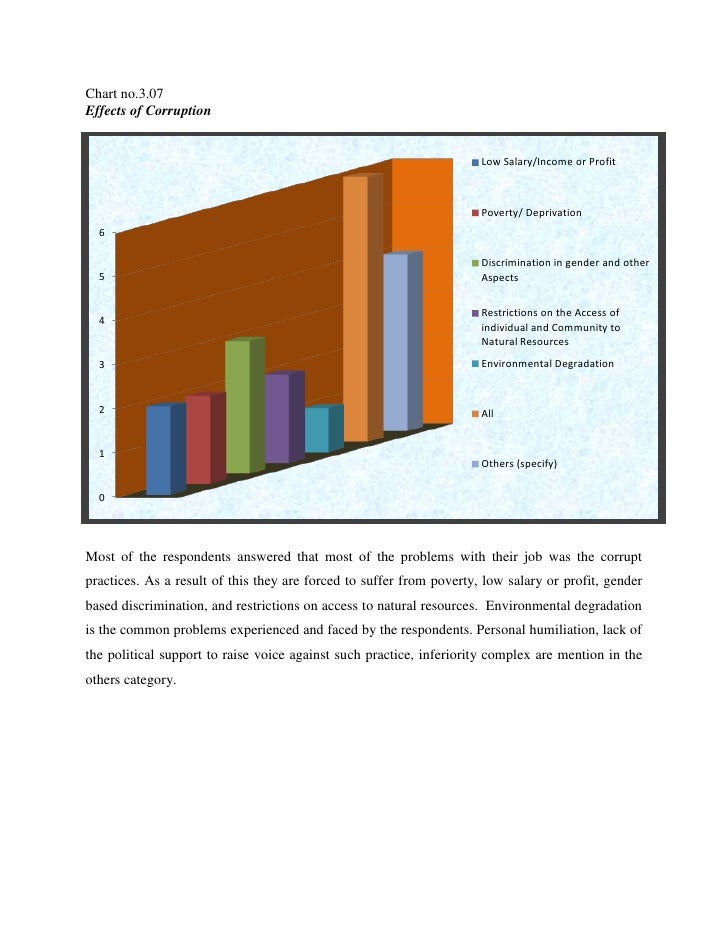
The table below, taken from one such research paper done on the impacts of corruption, shows the data collected from 20 respondents who were given questionnares about the effects of corruption on their social lives:

Retrieved from http://www.slideshare.net/kpbnepal/the-impacts-of-corruption-on-the-social-and-environmental-sustainability-in-nepal-13083411


According to that survey done, most of the problems suffered in their jobs by these respondents was because of corrupt practices. Because of this they are forced to suffer from poverty, low salary/profit, gender discrimination, and lack of access to natural resources. (Nepal Labour Foundation, January 2011)

From the above it is clear that corruption has many adverse impacts on society, and that each and every country has to work hard towards eradicating corruption as much as they can in order to develop. As a conclusion, here is a quote from a famous leader, Dr. A.P.J Abdul Kalam: 


Source : http://izquotes.com/quote/98305
Hopefully this module was useful in explaining on what corruption is, and also some of the social effects of corruption.With this I conclude Module 2.

Dheenesh


References :

Corruption. (n.d). Retrieved 10 September 2013 from http://en.wikipedia.org/wiki/Corruption

Corruption Perceptions Index. (2012). Retrieved September 11, 2013 from http://www.transparency.org/cpi2012/results

Combating bribery and corruption. Ministry of Justice. (n.d). Retrieved September 5, 2013 from http://www.justice.govt.nz/policy/criminal-justice/bribery-and-corruption

Global Corruption Barometer. (2013). Retrieved September 6, 2013 from http://transparencynz.org.nz/index.php/indices-reports/global-reports/161-global-corruption-barometer-2013

The Effects of Corruption. (n.d). Retrieved September 01, 2013 from http://gnpai.org/researchlibrary/corruption/THE%20EFFECTS%20OF%20CORRUPTION.pdf

Monday, 26 August 2013

Industrial Revolution : Steam engines

Untitled photo of the Industrial Revolution. [n.d]. Retrieved August 14, 2013 from http://www.docstoc.com/docs/82864876/Industrial-Revolution---PowerPoint


So, steam engines. What are they? Steam engines are basically external combustion engines, as opposed to internal combustion engines, where the working fluid is separated from the combustion products.  These engines use boiling water to produce steam, which is pressurised and then used to produce mechanical power/rotational motion to power machinery, tools and/or vehicles. The usage of these engines date back as early as 2000 years ago, when they were used to remove water from coal mines and diamond mines.

Untitled picture of the Watt steam engine [n.d.]. Retrieved August 15, 2013 from  http://www.humanthermodynamics.com/ht-history.html

Shown above is one of the earliest and most popular examples of the steam engine, the Watt engine, made famous by its designer James Watt. A steam engine basically works in this way : Water is boiled to make steam in a boiler until it reaches extremely high pressures. The high pressured steam is then forced through pipes to pistons inside cylinders or turbines, where the high pressure drives the piston or turbine, thus converting heat and pressure into  mechanical work. The excess steam is then either released into the air, or condensed and pumped back into the boiler.

Steam engines were one of the main drivers of the Industrial Revolution as it was used in almost all industrial applications such as driving large machinery, locomotives, pumps, ships and farmyard vehicles.

One of the types of steam engines which are in use are called beam engines. Beam engines basically use a beam to transfer force from a vertical piston to a vertical connecting rod. These engines were mainly used to pump water out of mines or into canals, but in New Zealand they were used to pump fresh, clean water to reservoirs. One such example of a beam engine was first assembled in Western Springs, Auckland, and used to pump water to Mt Eden, Ponsonby and Khyber Pass.


As seen in the photo, the engine was built by John Key and Son, Engineers and Shipbuilders, in the year 1877. In the year 1879 it started its work pumping water and was officially decommissioned in the year 1928. When running at maximum capacity, it used to pump about 2 million gallons of water from Western Springs each day, until the water dam at Waitakere took over as the main water supply for the supply areas.
In the year 2008, the restoration project was completed and the engine was brought back to life where it now regularly runs at MOTAT, as a feature show for visitors and a reminder of the immense working history it once had. Below is a video of the actual running of the restored engine at the pump house :


No doubt these works of engineering are a marvel, and they were a boon to those who lived during the time of the Industrial Revolution, but what were some of the actual societal impacts of the development of this technology?

The development of this technology had a massive impact on society in many ways, ranging from transport, shipping, mining, farming, politics, economics and etc.

One of the main impacts was that production was hugely improved, and the development of these powerful engines in industrial use paved the way for mass production. Goods could now be produced cheaper and in mass quantities, and also with better quality.

Transportation costs were also improved, and people could travel cheaper with the improvement of locomotives and ships/boats. Goods also could be transported over long distances in shorter times, resulting in better and faster supply to meet demands, and increased input of work. Roads and canals were built, resulting in shorter travelling times and increased network of travellers and road users.

Before the steam engine was developed, there were factories and manufacturing plants, but those were slow and cumbersome as most of the work was done by humans or beasts of burden such as horses, mules, and buffaloes (in farming). More and more factories were built as a result of the usage of steam power, as a result more and more jobs were offered, and cities became more populated and popular as the quality of life improved. Coal also replaced wood as the fuel of choice.

The impact of this led to the first automobile, and sometime after that also led to the invention of the first airplane.

There are negative impacts which resulted from the advancement in technology, such as pollution, the depletion of fossil fuels, global warming, child labor and division of the different social classes, but it cannot be denied that the positives outweighed the negatives, and the advancement of the technology developed in those times are directly responsible for the technologically advanced and modern world we have today.

:)


References :

All Sands. (n.d.). Retrieved August 16, 2013 from
http://www.allsands.com/potluck1/potluck1/steamenginehi_uvb_gn.htm


NZ Herald. (2008). Beam Engine Springs to Life. Retrieved August 15, 2013 from
http://www.stuff.co.nz/auckland/local-news/auckland-city-harbour-news/325451/Beam-engine-springs-to-life

Wikipedia. (2007). Steam Engine. Retrieved August 15, 2013 from http://en.wikipedia.org/wiki/Steam_engine

Whipps, H. (June 16, 2008). Retrieved August 14, 2013 from
http://www.livescience.com/2612-steam-engine-changed-world.html


Wednesday, 21 August 2013

Visit to Motat

Untitled photo of MOTAT [n.d.]. Retrieved August 12, 2013 from  http://www.motat.org.nz/


So for our first Module, we were given our handouts and also a free pass to MOTAT, and we were to make a trip and observe all the historical technology on display. We then had to choose one technology to focus on , and instructed to focus on the history of the chosen technology as well as the societal impacts of it as well.

So it was on a sunny Wednesday afternoon that I decided to drive down to MOTAT, which was located about 10 minutes away from where I stay and make my trip.

On arrival and entry, one of the first things to attract my attention was the large tractor/steam engine puffing away right opposite the main entrance. I have always been attracted by engines and things that move, and I have a particular liking for large scale machinery as I have spent some time around them, thus I decided to make that the chosen technology that I will do my research about.


Monday, 12 August 2013

Societal context

Hi everyone. I thought that with the end of the subject Professional Practices, that would be the last of the usage of blogs in our coursework. But surprise surprise : we were told by Ms Rashika that we needed to have another blog for our subject APPT 6114, and it would be one of the major components of our coursework.

Don't get me wrong, it's not a nuisance or an inconvenience that we have to create and maintain our blogs regularly for the course. Its just that quite a few of us are doing Automotive Engineering, and most of us have our "heads stuck under the bonnet of a car", as our previous lecturer Andy Pivac always used to tell us, and the notion of electronic work and assignments are a bit far fetched to us :D

Anyway, this post is to kick start the blog , and hopefully Ms Rashika will be able to find some interesting stuff here to read. Enjoy :D